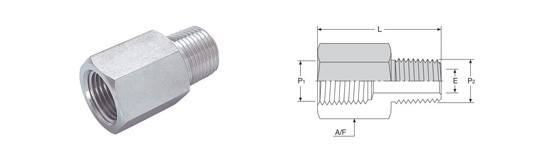
Chemical plants, refineries and offshore platforms move fluids that attack metal from the first day of service. Acids, chlorides and steam raise both temperature and corrosion risk across every joint. Carbon steel rarely survives that combination for long. Selecting stainless steel high pressure pipe fittings with the correct alloy grade keeps those joints tight through long production runs.
Where Aggressive Media Meets Metal
Alloy Grade as the First Line of Defence: Stainless steel high pressure pipe fittings in 316 and 316L resist sulphuric acid, seawater and process condensate far better than 304 equivalents. Added molybdenum, roughly two to three per cent, slows pitting at weld zones and thread roots. Monel and Hastelloy suit hotter chloride streams. Grade choice sets the ceiling for everything that follows.
Control Air under the Same Attack: Control air and actuator lines run through the same corrosive atmosphere as the process piping. Pneumatic couplings in stainless steel hold their seal when salt spray and acid vapour eat into plated brass alternatives. Quick connect designs also cut downtime during instrument changeovers on offshore decks, where a single air leak can stop a shutdown valve stroking.
Reading the Failure Modes before They Start
Chloride Attack beneath Insulation: Austenitic stainless steel performs well until chlorides concentrate under damp lagging at 60 to 200 degrees Celsius. Stress corrosion cracking then travels through the wall with almost no warning. Field crews often trace a leak back to insulation damage rather than the fitting, so corrosion resistance depends on the whole assembly. Inspection routes should reflect that reality.
Sensitisation and the Low Carbon Answer: Welding heat can precipitate chromium carbides at grain boundaries, leaving the metal open to intergranular corrosion in acid service. The L grades cap carbon near 0.03 per cent to limit that reaction. Correct heat treatment after forming restores the passive film and holds hardness within specification. Mill certificates confirm it, and asking for them costs nothing.
Pressure, Heat and the Numbers that Hold Up
Derating as Temperature Climbs: A fitting rated at 413 bar or 6000 psi at ambient loses a large share of that capacity by 400 degrees Celsius. Thermal expansion also loosens threaded joints through repeated cycling. Rating tables for stainless steel high pressure pipe fittings should be read at the actual design temperature, never at room conditions. Design margin disappears quickly otherwise.
Dissimilar Metals and Early Failure: Mixing metals along one line invites galvanic corrosion where two unlike components meet. Stainless bodies paired with plated steel adapters fail early in marine air. Matching the alloy across tube, fitting and pneumatic couplings removes that weak point and simplifies spares holding. Small savings on adapters rarely justify the later repair bill.
Checks that Catch Problems Early: Verification lists work better than long specification sheets when procurement time is short. Hydrostatic testing, helium leak checks and dimensional inspection each catch a different fault, and none replaces the others. Records held under ISO 9001:2015 trace a batch back to its melt, which settles most supply disputes quickly. These checks deserve priority on corrosive duty.
- Material certificates confirming 316 or 316L composition and carbon content
- Pressure ratings quoted at design temperature in both bar and psi
- Helium leak test results for vacuum and gas service
- Thread standards matched across the line, NPT or BSP throughout
- Traceability marking on every body, nut and ferrule
Building Lines that Outlast the Media
Long service life in corrosive plant comes from alloy choice, verified ratings and honest test data rather than the lowest quoted price. Engineers who specify against real design conditions replace fewer joints and record fewer unplanned outages. The specification sheet is the cheapest safeguard available. Speak to a manufacturing team with in-house testing before placing the next order.
